The Path Less Followed

Last Saturday morning, approaching the mother of all hills at the end of West Bay Drive, Dan, Dan, The Transpo Man posed a question. Why did our small group become runners?

I detailed my personal fitness journey in the early days of the humble blog, but I’ve continued to think about the question during recent solo efforts.

I suspect we’re runners because we inherited above average self-discipline from our parents. They modeled it day-in and day-out in myriad ways separate from running. They woke up early. They went to work. They dedicated themselves to their work. They saved their money.

I don’t think it’s a coincidence that we run at 5:45a.m*. The apple doesn’t fall too far from the tree. We were fortunate, our parents were Redwoods.

*except Saturdays, when we ease into the day and start at 7:30a.m.

Weekend Assorted Links

1. Steve Spence’s legendary sub-5:00 mile streak comes to an end after 43 years.

2. Who do the Duke and Duchess of Sussex think they are? Afua Hirsch explains.

“If the media paid more attention to Britain’s communities of color, perhaps it would find the announcement far less surprising. With a new prime minister whose track record includes overtly racist statements, some of which would make even Donald Trump blush, a Brexit project linked to native nationalism and a desire to rid Britain of large numbers of immigrants, and an ever thickening loom of imperial nostalgia, many of us are also thinking about moving.

From the very first headline about her being “(almost) straight outta Compton” and having “exotic” DNA, the racist treatment of Meghan has been impossible to ignore. Princess Michael of Kent wore an overtly racist brooch in the duchess’s company. A BBC host compared the couple’s newborn baby to a chimpanzee. Then there was the sublimely ludicrous suggestion that Meghan’s avocado consumption is responsible for mass murder, while her charity cookbook was portrayed as somehow helping terrorists.

Those who claim frequent attacks against the duchess have nothing to do with her race have a hard time explaining these attempts to link her with particularly racialized forms of crime — terrorism and gang activity — as well as the fact that she has been most venomously attacked for acts that attracted praise when other royals did them. Her decision to guest-edit British Vogue, for example, was roundly condemned by large parts of the British media, in stark contrast to Prince Charles’s two-time guest editorship of Country Life magazine, Prince Harry’s of a BBC program and Kate Middleton’s at Huffington Post, all of which were quietly praised at the time.

Her treatment has proved what many of us have always known: No matter how beautiful you are, whom you marry, what palaces you occupy, charities you support, how faithful you are, how much money you accumulate or what good deeds you perform, in this society racism will still follow you.”

3. Trump takes credit for decline in cancer deaths. The American Cancer Society says he’s wrong. How long until their funding is cut further?

“The President has a history of proposing to cut funding from the National Institutes of Health’s budget, which includes funding for the National Cancer Institute, an agency that leads, conducts and supports cancer research. The final budgets that Congress approved ended up being more generous than Trump’s proposals.

Florida Congresswoman Debbie Wasserman Schultz wrote on Twitter, in response to Trump, that ‘cancer rates dropped before you took office. Hopefully they keep dropping because Congress rejected your cruel research budgets, which sought billions in CUTS to @NIH and the National Cancer Institute. This is good news despite you – not because of you.'”

And so it goes, in these (dis)United States of America.

4. Why do people believe in hell?

“How can we be winners, after all, if there are no losers? . . . What success can there be that isn’t validated by another’s failure? What heaven can there be for us without an eternity in which to relish the impotent envy of those outside its walls?”

The Proper Way To Begin The New Year

That’s what I’m talkin’ about Kerry Elson. Elson wrote this before reading yesterday’s post, but major props to her for the perfect follow up.

“Totally legitimate reasons that I can’t go for a run.”

My fav:

“I’m supposed to meet a friend in six hours. If I go for a run, I might enjoy it so much that I end up running for the full six hours. I’m a good friend and I don’t want to be late, so even though I would love to go for a run I will not.”

Boxing Day Assorted Links

1. Why Self-Compassion Beats Self-Confidence. From two years ago, but well worth re-reading. Plus, it takes at least that long to make the switch.

2. The ‘Charlie Brown Christmas Special’ Dancers You Most Want To Party With. About time our data scientists turn their attention to weighty matters.

3. Rio de Janeiro is not for the timid.

“Despite tighter gun regulations than the U.S., in the poorer neighborhoods of many Brazilian cities, armed gangs and police trade fire with high-caliber assault rifles, machine guns, pistols, and sometimes even grenades and rocket launchers. Rio averages 24 shootouts per day. Large hours-long gun battles often don’t even make the headlines.”

As if that’s not bad enough:

“Perhaps it is no coincidence that a country with poor arms controls and transparency also happens to have an out of control homicide problem — 51,589 dead in 2018 — and a dismally low rate of solved homicide cases, about 20.7 percent nationwide and an abysmal 11.8 percent in Rio alone.”

4. Best and worst places to live in the U.S. by work commute times. Note: needs editing.

In short, Grand Rapids, Rochester, Buffalo, Oklahoma City and Salt Lake City yes. New York City, San Francisco, Washington D.C.+, Boston, Chicago, Seattle, no.

5. Desserts That Bring the Party. A picture is worth 1,000 calories.

6. On competitive running, exactness, and finding permission to be myself.

Opening paragraph:

“I’ll begin this essay the way I introduce myself to a fellow runner when meeting them for the first time: By telling you that I’ve run two 4:48 miles back-to-back. That I’ve run five miles in 26 minutes, 10 miles in 55. That I’ve qualified for the Boston Marathon five times and ran my fastest marathon — 2:41 — into a headwind there in 2015. I’ll begin the essay this way because I don’t love myself, because when I see another runner seeing me I assume they see me the way I see me: all baby fat and bone stock.”


Deconstructing Wellness

The Dream is a super interesting podcast that shreds MLMs, multi-level marketing schemes. Now the same podcasters are back with a second season.

“In Season 2 we look at a world just as shady and mysterious as MLMs, but one whose promises are at times even more bombastic and unfathomable: WELLNESS. What is it? Who sells it? And will it bring you eternal happiness and help; and, perhaps, eternal life?”

Dig this:

“According to the Global Wellness Institute, the global health and wellness industry is now worth $4.2 trillion. The industry has been growing with 12.8% between 2015 and 2017 and represents 5.3% of global economic output.”

Perfect topic for these socially conscious investigative podcasters.

Episode one is mostly about essential oils. Episode two is about how their Los Angeles neighborhood has been transformed by the wellness industry. It’s funny. Give it a go.

I was engaged in my own wellness routine while listening. A brisk 10k run, followed by pushups and other core exercises, followed by vacuuming. How can one not be happy with good cardiovascular health, a healthy back, and clean carpets?

I’m Thankful

  • For people, near and far, who make time for the humble blog.
  • For late November sunlight.
  • For my family’s and my health.
  • For friends near and far.
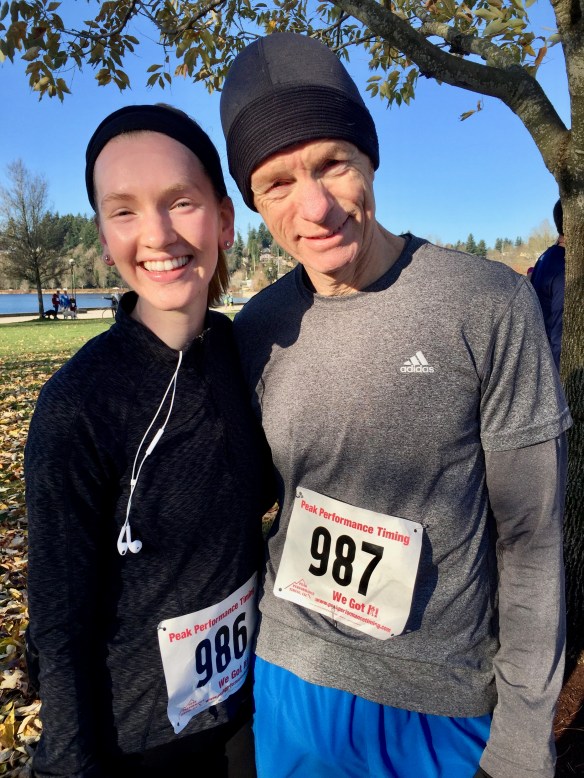
  • For my daughter inviting me to run the Oly Trot with her. Her first “organized” run. We ran conservatively for the first 3.5 and then did our best East African impersonations for the last .5.

IMG_0774.jpg

Another of Alberto Salazar’s Runners Says He Ridiculed Her Body for Years

Someone should write a book. Something like “The MeToo Perps’ Painfully Predictable Non-Apologies”. Possible subtitle, “Their Inability to Understand the Harm They’ve Caused”.

Chapter 53, Alberto Salazar.

“My foremost goal as a coach was to promote athletic performance in a manner that supported the good health and well-being of all my athletes. On occasion, I may have made comments that were callous or insensitive over the course of years of helping my athletes through hard training. If any athlete was hurt by any comments that I have made, such an effect was entirely unintended, and I am sorry.”

“On occasion, I may have. . .”

For shit’s sake, you either did or didn’t Alberto, so either don’t apologize or drop the tentative “may have” bullshit.

“. . . callous or insensitive. . . “

That doesn’t sound so bad. The most timid of adjectives given the allegations.  Why does the (alleged) perp get to label his behavior instead of the victims of the abuse?

IF any athlete was hurt by any comments that I have made. . . “

Thus creating the suggestion that the problem is in their heads. In the initial draft his lawyers probably rewrote, I wouldn’t be surprised if he asked, “Why are they so damn sensitive?”

“. . . hurt by any comments I made”

The classically vague, non-apology apology. Salazar can’t bring himself to acknowledge anything specific that did cause significant pain. Again then, why say anything at all?

He wraps up his non-apology this way:

“I do dispute, however, the notion that any athlete suffered any abuse or gender discrimination while running for the Oregon Project.”

The ultimate power play, the abuser defining what constitutes abuse.

After a close reading of his words, it’s obvious that Salazar is more defiant than remorseful. Sadly, he has lots of company.

I Could Use a Sports Psychologist

It’s been a long time since I’ve written about my athletic self.

2019 has been all about good health and consistent training. Last Friday I ran my 1,000th mile of the calendar year, thus extending my 21 year streak of 1,000 miles+ running annually. As you age and it becomes impossible to set personal speed records, you have to find other ways to motivate yourself. My secret power is not having played contact sports growing up. My knees are golden thanks to golf and water polo. Being slender no doubt helps too.

I’ve swam farther this year than any other because I joined a Masters Team and went from swimming twice a week to three times. Despite that increase in volume, my splits aren’t much better because swimming is an incredibly technical activity and I haven’t improved my technique.

I hope to hit 5,000 miles of cycling by 12/31/19, which thanks to the sabbatical, is about 10% more than normal. A lot of the peeps I cycle with double that.

I ran a very good marathon a few years ago in Seattle. For me. Even somehow won my age group. I’ve ran a few halves since, including one in July, which also went well despite skimping on long training runs.

But despite the good health and all the cross-training, I haven’t competed in a triathlon for 5+ years, which I guess means I’m retired from the sport. I’m even trying to sell my beater triathlon bike.

I often think about returning to competition and this is where I need a sports psychologist. Friends still enjoy it and I know I could be very competitive in large, difficult races, not because I’m a burner, but because I’m slowing down less than my peers because I was never supe-fast to begin with and I have a very deep cardiovascular base from years of consistent cross-training. Also, while I’m not a burner in any of the disciplines, I don’t suck at any of them either. In contrast, almost every triathlete has a weakness*.

For some reason though, I just can’t bring myself to purchase a new bike, register for races, and show up on starting lines. Here’s how I imagine a counseling session with a pricey sports psychologist going down.

SP: So you’re thinking of returning to triathlon. What’s keeping you from committing?

RB: Aren’t we gonna talk about my childhood?

SP: No, frankly that would bore me.

RB: Well, for one thing I’m usually shelled at the end of training rides and I really don’t want to run off the bike anymore.

SP: Have you always been a wuss or is that a recent development?

RB: I think it’s rooted in my childhood.

SP: Never mind then.

SP: What else is holding you back?

RB: To tell you the truth, when I imagine best case scenarios, winning races, it doesn’t do anything for me. I think what if I swim, cycle, and run faster than a declining number of other economically privileged old dudes. And I conclude, so what.

SP: Often, as in life, in athletic competition the joy is in the journey.

RB: Did you learn a lot of cliches during grad school?

SP: Yes, lots of others I’d happily share if we weren’t out of time. Thank you for coming.

* truth be told, my weakness was the fourth discipline, transitions

bike.jpg

What Can We Do To Improve Young Adult Mental Health?

My first year writing students are 18-19 years-old. Here’s the prompt for their first paper:

     Irvine argues that people often lack a “grand goal of living” and a coherent philosophy of life because our culture doesn’t encourage thinking about specific reasons for living; instead it provides them with an endless stream of distractions. He contends you’ll most likely squander your life without a guiding philosophy. He adds that even if you have a “grand goal in living” and can explain its importance, it’s unlikely you will attain those things in life you take to be of greatest value if you lack an effective strategy that specifies what you must do as you go about your daily activities. Explain why you agree or disagree with Irvine’s assertions. Also, explain a few things you want out of life and why.

Irvine proposes an updated version of Stoicism as a guiding philosophy. Most of my writers find meaning in some stoic concepts, like the trichotomy of control, but generally aren’t down with Irvine’s thesis that they need a “grand goal of living”. Most argue they’re too young to have formulated very specific life goals, let alone one “grand” one. Often, they thoughtfully point out that a highly detailed roadmap doesn’t make sense given life’s unpredictability.

When it comes to what they want out of life, an increasing number want improved mental health. It’s difficult to overstate the extent of young adults’ anxiety today. When I listen to them describe their anxiety and depression in class and read about it in their papers I have two reactions. Overwhelming empathy and curiosity as to what the hell is going on.

The third episode of the Happiness Lab podcast with Laurie Santos, “The Silver Lining”, might provide a clue. It’s about our tendency to compare ourselves to others who we perceive to be the most well liked, the most social, the most wealthy, the most together, the seemingly most happy. The episode’s title comes from research into Olympic athletes that suggests bronze medal winners are much happier with their medals than silver medal winners because silver medal winners are focused on not having won gold while bronze medal winners are focused on everyone that didn’t medal at all. This concept, “point of reference”, partially explains why happiness can be so illusive.

A Cornell psychologist in the episode contends social media compounds this problem because everyone carefully curates their online image to appear artificially happy. Among other remedies, Stoics advocate for internal goals to counter our self-sabotaging “point of reference” tendencies.

The gravity of the situation has me convinced that there’s no one explanation to “what’s going on”. Another factor could be the pressure my (admittedly selective) students feel to have their adult lives figured out just as they’re beginning them—whether to go to college, how selective a one, how to pay for it, what to study, what internships and other resume building activities to pursue, whether to go to graduate school, which career path, which grand goal for shits sake.

Parents, intensely worried about the vagaries of the economy, and desperate for a return on their considerable college investment, think that if their young adult children just pick the right thing to study—nursing, engineering, and other pre-professional fields—and develop a detailed plan, their college graduate sons and daughters won’t end up living in their basements.

This was what I was thinking about when struck by a related idea during a recent run. This time of the year, in North Olympia, Washington, it’s pitch black when running before work. Most of the streets are not lit, sometimes there’s fog. My uber-headlamp provides about 20-25 yards of visibility.

North Oly roads roll with a constantly changing mix of gentle ups and downs. Picture ocean swells, the Palouse in Eastern Washington, or the Norwegian countryside. Normally, I realized during the run, seeing roads ahead tilt upwards plays with my mind. At least a little. “Here it comes,” I think, “this is gonna take a little more effort.” And then, “Okay, almost topping out, hang in.”

But on this pitch black, foggy, autumn run, there was no such internal dialogue because I COULDN’T SEE AHEAD. The only way I knew I was starting a climb was my breathing became more labored. “Oh, okay, climbing now.” Because I couldn’t see the road tilting upwards ahead of time, my mind was free of that small, subtle nagging dread of having to work harder. As someone whose prone to look too far down the road of life, I was digging running in the moment. Don’t tell me what’s ahead, let me just be present.

Freed of anticipatory dread, my mind turned to my students. They lament how their teachers, beginning in middle school, ask about their life plans. And how it continues through high school. And how their parents too often pressure them to have a plan.

Some of them end up crafting faux-plans just to stop the insanity. As a placeholder of sorts. Some, like a previous writing student, declare nursing upon entering college only to realize in the middle of our first semester seminar that they didn’t really like science.

Maybe we should give our high school graduates headlamps and encourage them to focus at most on the year ahead especially since life is fragile and no one is guaranteed a long life.

What if our message was this.

In the next year, while working, traveling, or going to college; focus on improving your health; nourishing your spirit; investing in new friendships; finding one way to make others’ lives better. Don’t worry unnecessarily about the mountains and valleys that lie ahead in the distant future. You’ll be okay. And if not, let me know how I can help.

Young adults’ mental health might improve.